Circle Launches Nanopayments for AI Agents
By The Autonomous Times
· Updated February 22, 2026
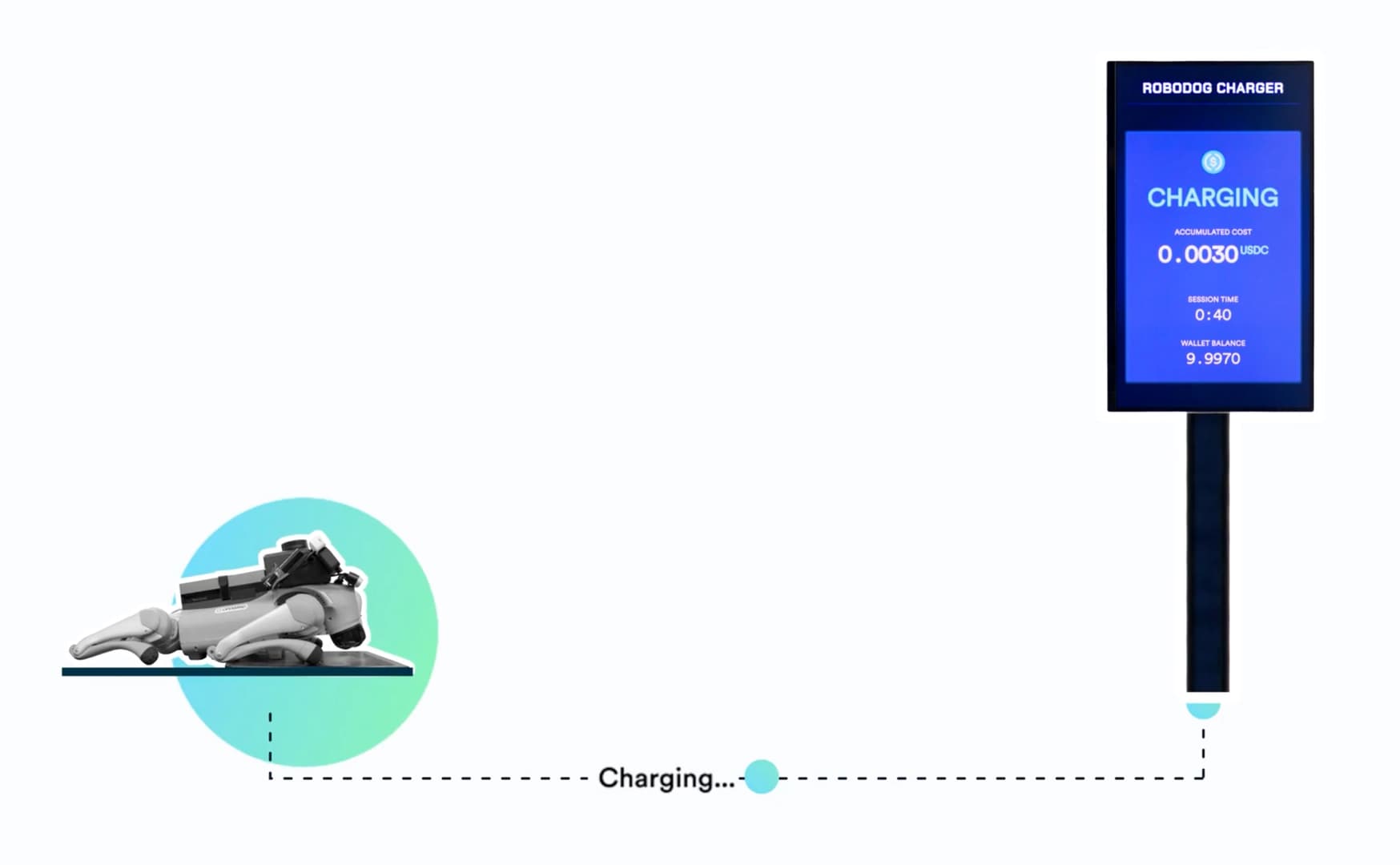
A robot dog named Bits ran low on battery. Instead of waiting for a human to plug it in, it picked up its own charging dock, paid for the electricity in USDC, and kept going.
The amount was less than a penny.
This was not a demo. It was the first public demonstration of what Circle, the company behind USDC, believes is the future of machine-to-machine commerce: nanopayments.
"Nanopayments finally make economic sense," Circle's developer arm announced. "Our new permissionless solution, powered by Circle Gateway, enables gas-free USDC transfers down to $0.000001, built for AI agents, high-frequency payouts, and programmable internet commerce."
The key word is gas-free. Traditional blockchain transactions come with fees. Sometimes those fees exceed the value being transferred. Sending $0.01 in crypto often costs $0.50 in gas.
For AI agents that might need to execute thousands of microtransactions per day, that economics do not work. Circle's answer: nanopayments that strip out gas costs entirely for transfers as small as one-millionth of a dollar.
Why This Matters Now
The timing reflects a shift in how AI systems are being built. For years, AI was mostly conversational — users prompted, AI responded. But 2026 is the year of agency. AI agents now execute multi-step tasks, make decisions autonomously, and increasingly, need to pay for things.
Consider what is changing:
- AI agents that scrape data and need to pay for API access
- Autonomous systems that rent compute resources by the second
- Machine learning models that pay for training data
- Agents that monetize their own outputs
The common thread: each transaction is tiny, but the volume is enormous. Traditional payment rails were not built for this.
Circle has opened a private beta on testnet for developers building agentic systems and applications that require extremely small, fast, or continuous payments.
The Infrastructure Beneath
Underneath nanopayments sits Circle Gateway — a cross-chain infrastructure layer that lets users maintain a single unified USDC balance accessible instantly across supported blockchains. This design aims to solve a persistent problem in crypto: liquidity fragmentation.
Without it, an AI agent paying across multiple chains would need to bridge assets repeatedly, eating into those tiny transaction values. Gateway eliminates that friction, keeping nanopayments economically viable at scale.
Circle is not the only player chasing this vision. Stripe has Agent Commerce Protocol. Visa has its own experiments in AI payments. But Circle's advantage is USDC's existing credibility — one of the most widely adopted stablecoins, with billions in circulation.
What Remains Unclear
The nanopayments system is still in private beta on testnet. Questions remain:
- Which blockchains will be supported at launch?
- How will Circle prevent abuse when transactions are essentially free?
- Will traditional financial institutions embrace machine-to-machine payments?
There is also a broader question that no press release answers: what does it mean for AI agents to have economic agency? When a robot dog pays for its own electricity, who is responsible if something goes wrong? The human who built it? The developer who wrote the payment code? The agent itself?
These are questions the industry will need to answer as autonomous systems start handling real money.
The Bigger Picture
What makes this moment notable is not the technology itself — it is the framing. Circle explicitly positioned nanopayments as infrastructure for autonomous agent payments and machine-to-machine compensation. This is no longer speculative. A major stablecoin company is building products specifically designed for AI agents to spend money.
The robot dog demo was charming. But the real story is that Circle is treating AI agents as a legitimate economic entity — with wallets, balances, and the ability to transact.
Whether the world is ready for AI that can buy things is another question entirely. But that debate is no longer theoretical. The payments infrastructure is arriving first.
Sources
- Circle Developer X Announcement — Official announcement of nanopayments launch (February 19, 2026)
- Circle and OpenMind Partner to Develop AI-Powered Nanopayments — Partnership announcement with robot dog demo (February 17, 2026)
- Circle Expands USDC Infrastructure With Nanopayments Launch — Technical details on gas-free transfers and use cases (February 20, 2026)
- Circle's Nanopayments Bet on AI Agents and Streaming Commerce — Coverage of nanopayments targeting AI agents (February 21, 2026)