Deutsche Telekom Launches World’s First Network-Based AI Call Assistant
By The Autonomous Times
· Updated March 2, 2026
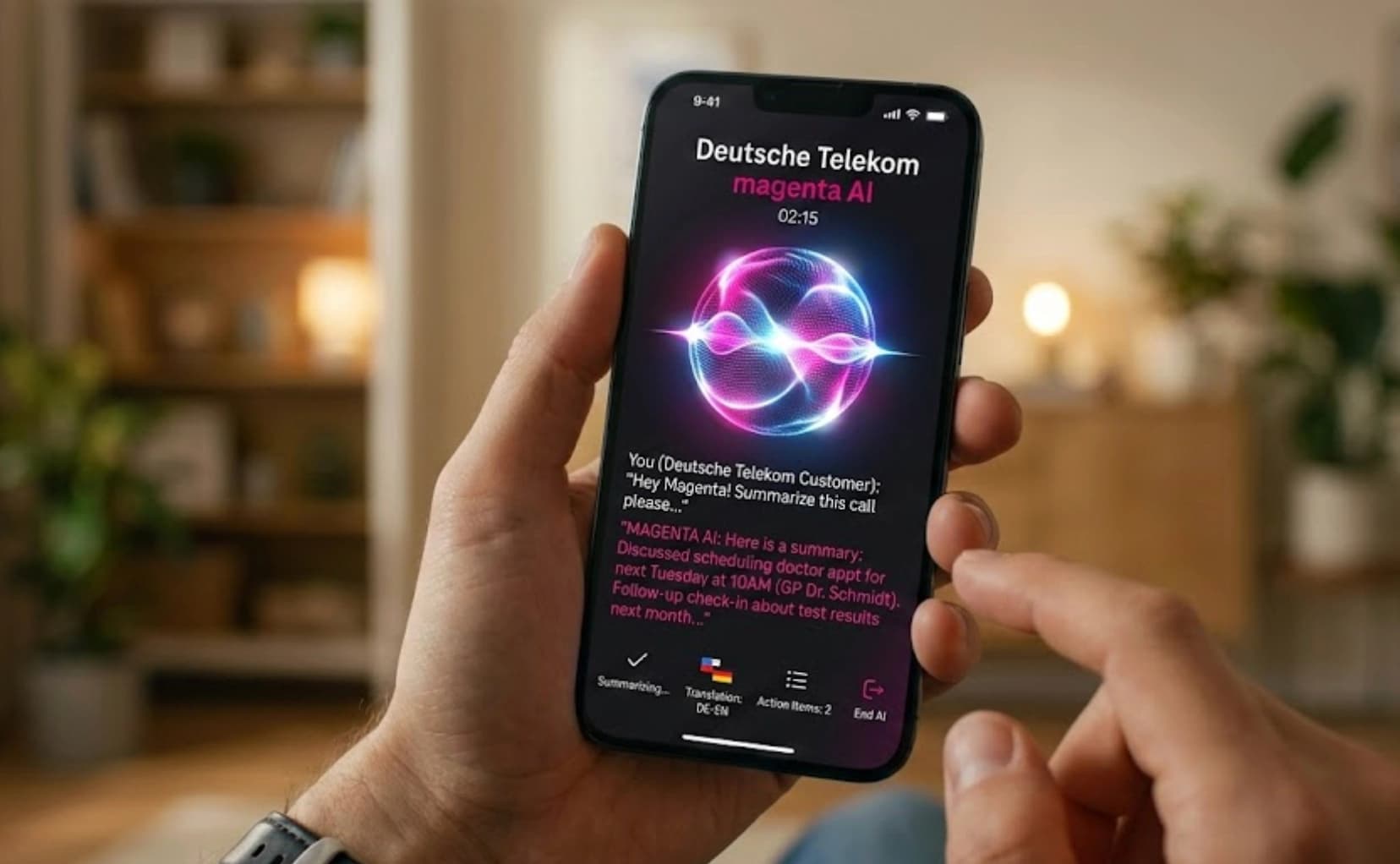
The phone call is about to get a major upgrade—and you won't need to install anything.
Deutsche Telekom unveiled the Magenta AI Call Assistant at MWC Barcelona, calling it a world first: an AI that works directly inside the telecom network, not inside an app on your phone. Say "Hey Magenta" during any call, and AI assistance appears instantly.
"We're the first in the world to offer these network-based AI functions," said Abdu Mudesir, Board Member for Product & Technology at Deutsche Telekom. "We remove barriers—no apps, no special devices, no technical complexity. AI becomes simple, intuitive and available to everyone."
No App Required
That's the key difference. Unlike AI assistants that require downloading an app, subscribing to a service, or owning premium hardware, this works on any phone call. The AI lives in Deutsche Telekom's network infrastructure, activated by voice command when needed.
The first features include live translation, automatic call summaries, and the ability to answer questions during a conversation. If you're discussing dinner plans, the AI can interject with restaurant options. If you're scheduling a doctor's appointment, it can fill out forms while you speak, asking clarifying questions like "Window or aisle?" before confirming the booking.
The system is opt-in. Customers must explicitly activate it, and all call participants are notified when the AI is listening. Without activation, no conversation content is stored or analyzed.
Built with ElevenLabs
The assistant was developed in partnership with ElevenLabs, the AI voice research company known for its realistic text-to-speech and voice AI models. This gives Deutsche Telekom advanced voice capabilities that can process speech in real time—something that traditionally requires significant computing power and introduces lag.
The service launches first in Germany later this year, with support for up to 50 languages planned over the next 12 months.
Beyond Calls: AI Glasses and Network Agents
The announcement wasn't limited to phone calls. Deutsche Telekom also showcased a concept for AI Glasses based on the RayNeo X3 Pro platform, demonstrating hands-free AI interaction—text translation, product identification, and contextual information displayed in the user's field of view.
On the infrastructure side, the company presented its MINDR multi-agent AI system for network operations, developed with Google Cloud. MINDR monitors networks, predicts failures, and can autonomously take corrective action—a preview of self-healing telecom networks.
The Bigger Picture
For the telecom industry, Deutsche Telekom's announcement represents a shift in strategy. Rather than competing on hardware or data plans, carriers are racing to embed AI directly into their core services. SK Telecom announced a similar transformation at MWC this week, rebuilding its entire business around AI.
"AI is becoming the key technology of our time," Mudesir said. "It will determine competitiveness, technological performance, and Europe's digital sovereignty."
The question now is whether customers want AI listening in on their calls—even with consent. And whether rivals can match the network-based approach or get stuck in the app store.
Sources
- MWC 2026: World premiere of AI-powered call assistant — Deutsche Telekom
- Deutsche Telekom reimagines phone calls with AI embedded in the network — Deutsche Telekom
- Deutsche Telekom Showcases AI at Scale at MWC 2026 — TelecomLead