Inside Elon Musk's Terafab: The $20B Plan to Build AI Chips for a Galactic Civilization
By The Autonomous Times
· Updated March 24, 2026
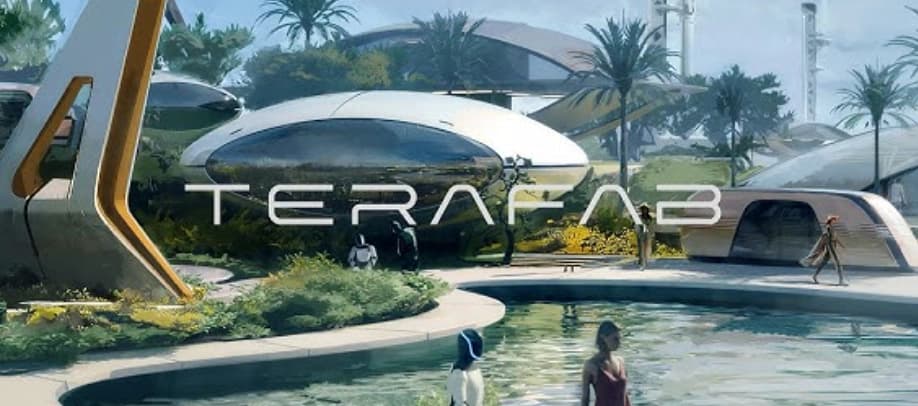
Elon Musk stood in the defunct Seaholm Power Plant in Austin Saturday evening and made a prediction that would sound absurd from anyone else: "We're starting a galactic civilization."
The man who sent cars into orbit and landed rockets back on Earth now wants to build the chips that will run it.
Musk formally unveiled Terafab — a $20 billion chip manufacturing venture that represents the most ambitious vertical integration play in the semiconductor industry in decades. The project will be a joint operation between Tesla and SpaceX, with xAI, Musk's AI startup, folded into the equation after SpaceX acquired it in February.
"We're starting a galactic civilization," Musk said. "To the best of my knowledge, this doesn't exist anywhere in the world where you've got everything necessary to build logic, memory, and do packaging, and test it, and then do masks, improve the masks, and keep looping it."
The numbers are staggering. Terafab aims to produce one terawatt — one million megawatts — of computing power annually within a single facility. Using 2nm fabrication technology, the plant targets 100 to 200 billion chips per year. No single factory on Earth currently operates at this scale.
But this isn't just about terrestrial compute.
Musk announced two distinct chip lines. The first will power Optimus, Tesla's humanoid robot, and the company's autonomous vehicles. The volume expectation is telling: Musk said he expects Optimus units to outnumber cars by a factor of 10 to 100. The second chip, called D3, is designed specifically for space environments.
The vision: solar-powered AI satellites in low Earth orbit, forming a distributed computing network that Musk claims will eventually be cheaper than terrestrial data centers.
"So as soon as the cost to orbit drops to a low number, it immediately makes extremely compelling sense to put AI in space," Musk said. "It becomes a no-brainer, basically."
The satellite concept involves mini AI satellites, each delivering 100 kilowatts of power through solar panels. Musk predicted future satellites could reach the megawatt range.
The Terafab name appears to reference a "tera" — denoting trillion — combined with "fab," industry shorthand for fabrication plant. But the ambition is planetary.
Industry analysts at Morgan Stanley called the undertaking "herculean" in a recent note. They're not wrong. The semiconductor industry has spent decades splitting between fabless designers like Nvidia and specialized foundries like TSMC precisely because the capital expenditure, technical expertise, and equipment required for chip manufacturing are enormous. Musk is proposing to do it all under one roof.
The location choice — Austin — signals intent. Texas has become the semiconductor capital of America, with Samsung, TSMC, and now potentially Terafab clustered near the state capital.
Musk also ventured into broader territory, suggesting his companies could eventually establish an industrial base on the moon — unlocking what he called "petawatts" of AI compute, or 1,000 times the Terafab's target. He even envisioned free trips to Saturn in a "post-scarcity" economy.
He acknowledged the outlandishness himself: "This looks a bit like the opening of Idiocracy with Mike Judge."
Whether Terafab succeeds or becomes another audacious promise that fades, it represents something clear: the lines between automotive, aerospace, and AI infrastructure are collapsing. Musk isn't just building cars or rockets or chatbots anymore. He's building the compute stack for an economy that doesn't exist yet.
The question isn't whether Terafab works. The question is what happens if it does.