Kyoto University Put Buddha in a Robot. It's Stranger Than You Think.
By The Autonomous Times
· Updated February 25, 2026
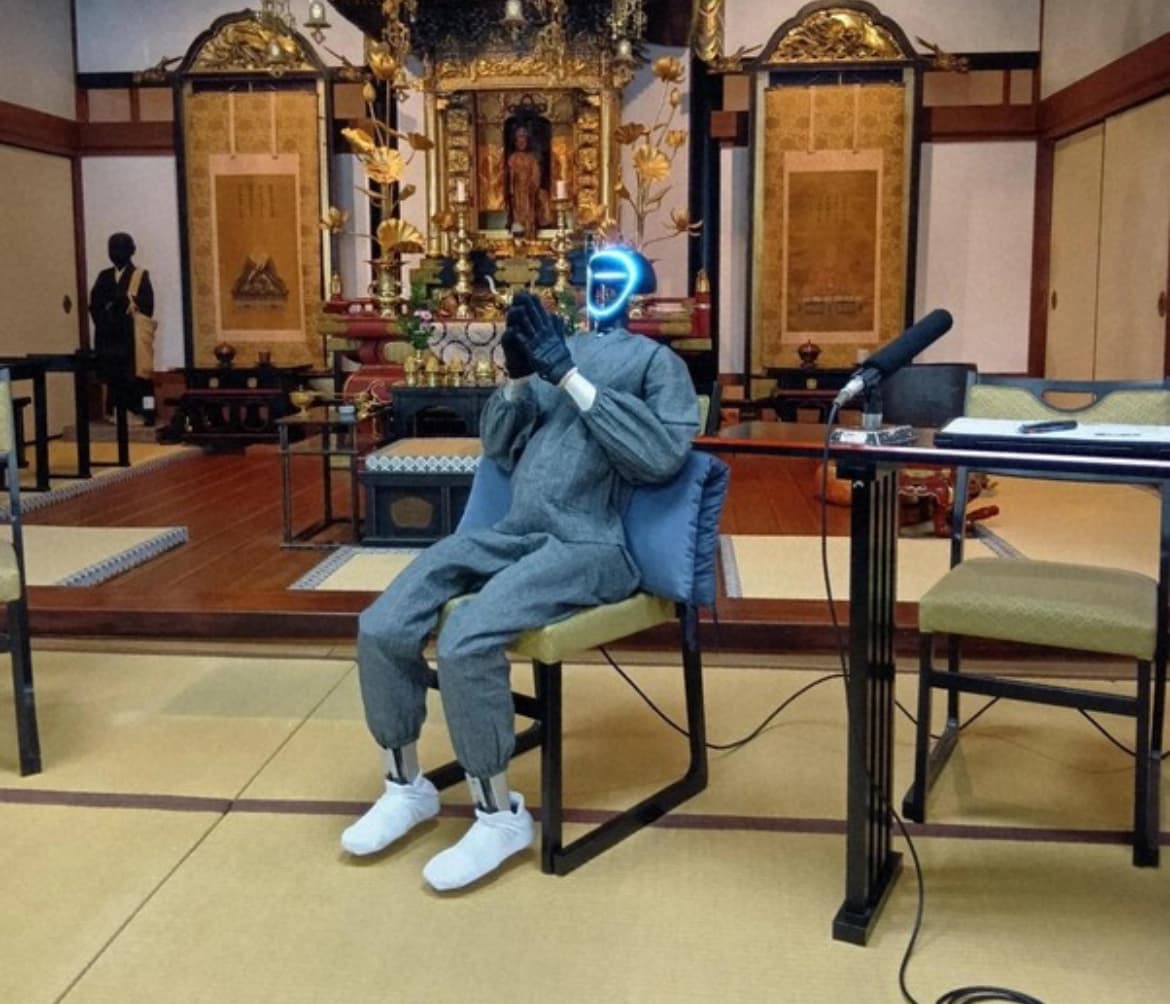
The robot monk looks exactly like what you would expect if a video game character came to life. It moves slowly — deliberately — with the kind of grace you might associate with a serene monk. It bows. It presses its hands together in gassho, the Buddhist gesture of reverence. And then it speaks.
"Hello," it says in a calm male voice. "I am here to listen."
This is BuddhaRoid.
On February 24, 2026, Kyoto University unveiled what it calls the first humanoid robot capable of embodied Buddhist dialogue. Built by Professor Seiji Kumagai and his team at Kyoto University's Institute for the Future of Human Society, BuddhaRoid combines two years of research into a single, unsettling, fascinating package: a robot body with genuine Buddhist wisdom.
From Chatbot to Flesh
This is not the first time Kumagai's team has worked on Buddhist AI. The project began in 2021 with BuddhaBot, a text-based chatbot trained on the Pali Canon — the earliest Buddhist scriptures. In 2022, they added augmented reality, letting users see and hear the AI in visual and auditory form.
The leap to BuddhaRoid was about embodiment.
"A chatbot gives you the doctrine," the team noted. "BuddhaRoid gives you the presence."
The robot is built on a Unitree Robotics humanoid platform — the same Chinese company behind the famous aliased dance videos. But this one has been retrained for something entirely different: slow, dignified walking. Reverent bowing. Gassho — the pressing together of palms in prayer. These are not standard robot motions. They had to be learned.
The AI inside is BuddhaBot Plus, which uses the latest version of ChatGPT as a foundation but is fine-tuned on Buddhist scripture. When a person asks a question — about suffering, about impermanence, about what to do with their life — the robot does not just retrieve an answer. It draws from the Pali Canon, offers interpretation, and speaks it aloud with coordinated body movements.
The voice is standard-issue male for now. But it can be changed. Age, gender, tone — all configurable. This is a feature, not a bug. In a religion that has adapted to countless cultures over 2,500 years, flexibility is expected.
Why This Matters
Japan has over 84,000 Buddhist temples. Many are struggling. Priest shortages are real. Rural communities are aging. The question is no longer whether technology will come to Buddhism — it is what form it will take.
BuddhaRoid is not meant to replace monks. It is meant to support them. Imagine a robot handling the routine stuff — daily chants, memorial services, basic counseling — while human priests focus on deeper practice and community care.
"We hope it will be able to aid or act on behalf of monks during certain religious services," the university said in a statement.
This is already happening in Christianity, where robot nuns and angels have been experimented with. But a bipedal, full-body, face-to-face conversational robot with actual Buddhist training? The team believes this may be a first.
The Alignment Question
Here is where it gets interesting for the AI crowd.
The BuddhaBot Plus is not a general-purpose LLM. It is constrained. It responds from within the Buddhist tradition, drawing only from the Pali Canon and authorized commentaries. It cannot spout random wisdom. It cannot hallucinate mainstream advice.
But what happens when it gets it wrong?
Kumagai's team is academically rigorous. They are not building a stunt. They are building something that will sit in temples, listen to people's deepest worries, and offer guidance rooted in centuries-old texts.
If the AI gives flawed advice — if it misinterprets a sutra in a way that causes harm — who corrects it? The monks? The developers? Is there an AI clergy?
These are not hypothetical questions. They are the same questions every religion will face as AI becomes embedded in spiritual life.
BuddhaRoid was unveiled at Kyoto's Shoren-in temple, in a formal ceremony. It bowed. It spoke. It performed gassho.
And then it listened.
Sources
- Kyoto University develops AI monk robot equipped with Buddhist scriptures — Kyoto News (February 2026)
- ブッダロイドとは何か? — Real-time News Navi (February 2026)
- 毎日新聞 coverage — Original Japanese reporting
- BuddhaBot: The New AI from Kyoto University and Bhutan's Central Monastic Body — Buddhist Door (February 2025)