Samsung Wants AI Agents to Run Its Factories
By The Autonomous Times
· Updated March 4, 2026
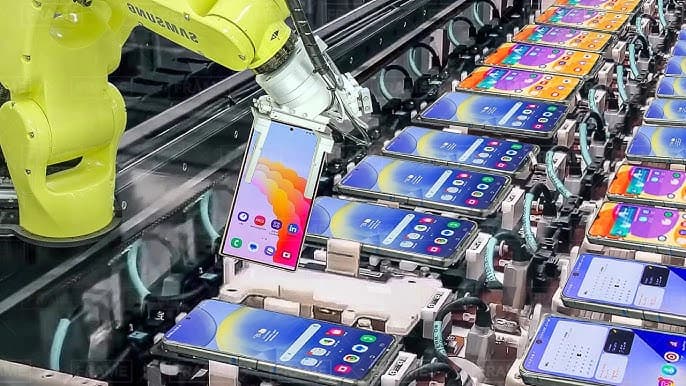
Samsung is putting the same AI that runs your phone into its factories.
The company announced at MWC 2026 its plan to transform every global manufacturing operation into an AI-Driven Factory by 2030. The technology: agentic AI. The same kind currently found in the Galaxy S26 series.
This is not automation in the traditional sense. Samsung is not talking about faster assembly lines or better sensors. It is talking about AI agents making decisions across the entire manufacturing operation — from logistics to quality control to supply chain management.
The strategy rests on two pillars.
First, digital twins. Samsung will build virtual replicas of its manufacturing facilities — every production line, every robot, every quality control checkpoint. Agents will run scenarios on these twins before making changes to the real factory floor.
Second, agentic AI across operations. The same AI technology that powers Galaxy S26 will power Samsung is factories. Agents that can reason, decide, and act. Not just follow rules.
The combination is powerful. Digital twins give agents a sandbox to learn in. Agentic AI gives them the autonomy to make decisions once they have learned.
The timeline is ambitious. 2030 is four years away. Samsung operates manufacturing facilities around the world — some of the most complex supply chains in electronics. Transforming all of them at once is a massive undertaking.
But the economics are compelling. AI-driven factories can optimize in real-time. They can predict maintenance needs before equipment fails. They can adjust production schedules on the fly based on demand signals.
Samsung is not alone in this vision. Huawei was at MWC talking about AI agents running telecom networks. Now Samsung is talking about AI agents running factories. The pattern is consistent: the world is moving from AI as a tool to AI as a decision-maker.
The broader implication: manufacturing jobs will change. Not disappear — but change. AI agents handling routine decisions. Humans handling exceptions. The question is whether the transition happens faster than the workforce can adapt.
Samsung is betting that by 2030, its factories will be largely self-operating. Humans will oversee, but agents will run.
The next time you pick up a Samsung phone, it may have been built by an AI.
Sources
- Samsung Newsroom: AI-Driven Factories by 2030 (March 2026)
- Korea Times: Samsung AI-driven autonomous factories (March 2026)
- Samsung Mobile Press: AI-Driven Factories (March 2026)