The Tech Corps: America Is Sending AI Volunteers Abroad to Counter China
By The Autonomous Times
· Updated February 25, 2026
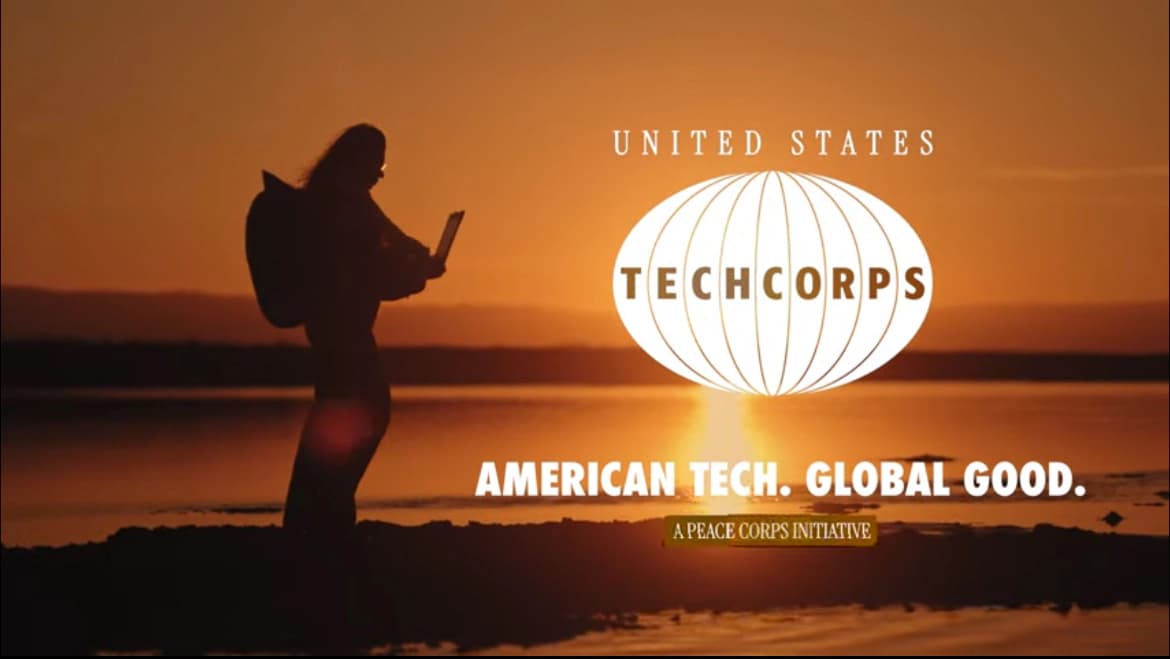
The United States is deploying a new kind of volunteer abroad. They will not teach English. They will not dig wells. They will carry something far more valuable in 2026: American artificial intelligence.
The White House announced Tech Corps on Friday, a Peace Corps-style initiative designed to export U.S. AI technology to developing nations. The program marks the most concrete step yet in Washington effort effort to counter China growing dominance in global AI adoption and it represents a fundamental shift in how America plans to compete for technological influence.
How It Works
Tech Corps volunteers will be recruited from American STEM graduates and professionals with AI expertise. They will serve 12 to 27 months in countries participating in the American AI Exports Program, announced last July under a Trump administration executive order.
Their mission: provide last-mile support for deploying American AI solutions in agriculture, education, health, and economic development. The work is hands-on. Volunteers will help local institutions integrate AI into existing systems, co-develop models with national governments, and customize American technology for local contexts.
The Peace Corps website lists sample scenarios. In one, a volunteer helps integrate an American AI healthcare system into a local hospital workflows, trains medical and administrative staff, and adapts the system to the local language.
Volunteers receive housing, healthcare, a living stipend, and service awards upon completion — the same benefits that have drawn generations of Americans to the traditional Peace Corps. Deployments could begin as early as fall 2026.
The China Problem
The initiative exists because China is winning the developing world.
For years, American AI companies have led frontier research. OpenAI GPT models and Anthropic Claude dominate enterprise usage in developed economies. But in much of the Global South, a different picture is emerging.
Chinese AI products have surged in popularity because they are open-weight, customizable, and can run entirely on local infrastructure. Alibaba Qwen3 series, Minimax M2.5, and Moonshot Kimi K2.5 are among the most downloaded models on developer platform Hugging Face. Three of the most popular models on cloud inference service OpenRouter are Chinese. Chinese cloud providers are expanding abroad to offer low-cost AI services directly to businesses and governments in developing markets.
American proprietary models like GPT-5 and Claude are widely used by enterprise users in developed countries for their top-notch performance and reliability, but Chinese products can be attractive to users in the Global South for their cost efficiency, Kyle Chan, a fellow at the Brookings Institution, told Rest of World.
The economics are difficult to overcome. Chinese models often run on cheaper hardware, require less computational overhead, and are available under open-source licenses that allow full customization. For countries with limited IT infrastructure and tight budgets, this matters more than frontier-model performance.
What America Is Offering
The American AI Exports Program aims to export the entire U.S. tech stack: hardware, data systems, AI models, cybersecurity measures, and applications. The goal is not just to sell products — it is to embed American technology into the digital infrastructure of developing nations.
Michael Kratsios, director of the White House Office of Science and Technology Policy, announced the Tech Corps at the India AI Impact Summit in New Delhi. His message was clear: Real AI sovereignty means owning and using best-in-class technology for the benefit of your people.
India is expected to be one of the first countries to participate. The Commerce Department welcomed India involvement last week, ahead of the summit. India is also joining Pax Silica, a U.S.-led initiative to secure the global supply chain for silicon-based technologies, alongside Japan, South Korea, Singapore, the Netherlands, Israel, the United Kingdom, Australia, Qatar, and the UAE.
Will It Work
There is reason for skepticism.
I do not think any degree of persuasion or handholding from the U.S. Tech Corps volunteers would be able to overcome the sheer economic challenges and needs of a lot of businesses, individuals, and organizations outside the developed markets, Chan said.
The volunteers will not change the fundamental cost advantage that Chinese products offer. A country with limited IT infrastructure may prefer an open-weight model that runs on a single server over an American solution requiring cloud infrastructure and ongoing licensing fees.
But Tech Corps is not meant to win on economics alone. It is designed to build relationships, train local workforces, and establish American technology as the default choice for countries making long-term infrastructure decisions. The volunteers become advocates. The implementations create dependencies. The hope is that once countries adopt American AI systems, they stay with them.
The Bigger Picture
This is the most visible example of a broader strategy: turning soft power into technological influence.
The U.S. government has, over the past months, ramped up efforts to counter Chinese AI influence. The Tech Corps is one piece. The American AI Exports Program is another. The Pax Silica initiative secures supply chains. The National Champions Initiative aims to integrate foreign AI companies into the U.S. tech stack.
Together, they form a coherent theory of the case: whoever builds a country AI infrastructure first owns its digital future. The Tech Corps is America attempt to build that future one volunteer at a time.
Sources
- CNBC - U.S. launches Peace Corps-backed Tech Corps to help export AI, counter China — Breaking coverage (February 23, 2026)
- Euronews - The US Peace Corps launches new Tech Corps to bring AI expertise abroad — Program details (February 23, 2026)
- Rest of World - U.S. plans Peace Corps-style Tech Corps to counter China AI exports — Analysis of China competition (February 2026)
- Bloomberg - US Plans Peace Corps Revamp to Gain Edge in AI Race With China — Background on the initiative (February 20, 2026)
- Peace Corps - Tech Corps initiative announcement — Official program launch (February 2026)