Uber Is Building Its Own Robotaxi Infrastructure — And Spending $100 Million to Do It
By The Autonomous Times
· Updated February 25, 2026
Uber is done waiting for the robotaxi future to arrive. It is building the infrastructure to make it happen.
The ride-hailing giant announced plans to invest more than $100 million in autonomous vehicle charging hubs across major U.S. cities, the latest step in what has become one of the most ambitious autonomous vehicle pushes in the industry. The charging network will support Uber growing fleet of robotaxis, which the company expects to expand to at least 10 cities by the end of 2026.
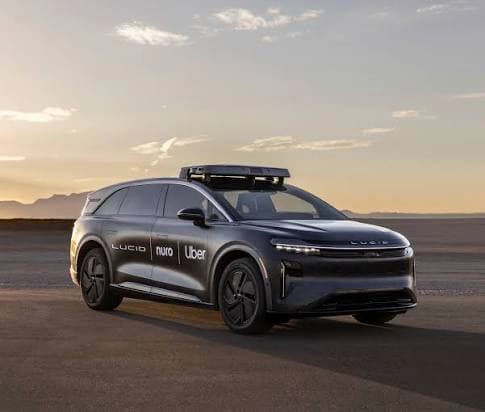
The announcement comes just weeks after Uber unveiled a first-of-its-kind robotaxi partnership with Lucid Motors and Nuro at CES 2026, revealing production-intent vehicles designed specifically for the Uber platform. Autonomous on-road testing began in December in the San Francisco Bay Area, with commercial rides expected to launch later this year.
The Charging Infrastructure Play
The $100 million investment represents something fundamental about Uber strategy: the charging network is as important as the vehicles themselves.
Uber plans to build DC fast charging stations at autonomous vehicle depots where it runs day-to-day fleet operations, plus pit stops throughout priority cities. The expansion begins in the Bay Area, Los Angeles, and Dallas before spreading to more cities.
The company is also partnering with charge point operators globally, including EVgo in New York, Los Angeles, San Francisco, and Boston, Electra in Paris and Madrid, and Hubber and Ionity in London. These utilization guarantee agreements are expected to support the rollout of hundreds of new chargers across these cities.
The logic is straightforward: robotaxis that spend hours charging instead of earning rides are not profitable. By building its own charging infrastructure, Uber aims to minimize downtime and maximize the utilization that makes robotaxi economics work.
The Lucid-Nuro Partnership
At CES 2026, Uber, Lucid Motors, and Nuro unveiled what they called the first autonomous ride-hailing vehicle developed exclusively for the Uber platform.
The vehicle combines Lucid premium electric vehicle engineering with Nuro autonomous driving technology. Key features include:
- A multi-modal sensor array with high-resolution cameras, lidar, and radars providing 360-degree awareness
- A roof-mounted Halo module with integrated sensors and an LED display showing passenger initials
- NVIDIA DRIVE AGX Thor computing for real-time AI processing
- Configurations seating up to six passengers with luggage space
- Interactive screens letting riders adjust climate, music, and heated seats
- Real-time visualization showing what the robotaxi sees and plans to do next
We not just launching a new ride — we paving the way for an entire ecosystem of autonomous mobility, the companies said in a joint statement.
Marc Winterhoff, CEO of Lucid Motors, called it the start of our path to extend our innovation and technology leadership into this multi-trillion-dollar market.
Jiajun Zhu, co-founder of Nuro, said the partnership would demonstrate what possible when proven AV technology meets real-world scale.
The Competitive Landscape
Uber push comes as the robotaxi race accelerates. The company currently offers robotaxis through its app in four U.S. cities plus Dubai, Abu Dhabi, and Riyadh. Its partners include Alphabet Waymo and China WeRide.
But the stakes are getting higher. Tesla, under Elon Musk leadership, has promised its own robotaxi service, creating direct competition for Uber core business. The difference is that Uber is not building its own vehicles — it is building the platform and infrastructure that connects multiple autonomous vehicle providers to its massive rider base.
Earlier this month, Uber said it was committing capital to vehicle partners to secure early supply and speed up deployments, leveraging what it calls its structural advantage: the platform itself. Millions of riders already use the Uber app. The theory is that when autonomous vehicles are ready, the riders will already be there.
What Comes Next
Uber expects to launch the first Lucid-Nuro robotaxis in the San Francisco Bay Area later in 2026. Volkswagen autonomous vans are planned for Los Angeles. The company aims to be in at least 10 cities by year end.
The charging network will be the backbone. Without reliable, fast charging, robotaxi fleets cannot operate profitably at scale. Uber is betting that building that infrastructure now — rather than waiting for third-party networks to catch up — will give it an advantage when the vehicles arrive.
The robotaxi future has been promised for years. Uber is no longer waiting. It is building the roads.
Sources
- Reuters - Uber to invest over $100 million in autonomous vehicle charging amid robotaxi push — Investment details (February 18, 2026)
- Nuro - Lucid, Nuro, and Uber Robotaxi — Vehicle specifications (CES 2026)
- CBT News - Lucid, Nuro, and Uber debut production-ready robotaxi at CES 2026 — Production details (January 2026)
- TechCrunch - Uber launches an AV Labs division to gather driving data for robotaxi partners — AV Labs division (January 2026)